
Search the knowledge base, browse our resources, and visit our Community Forum for more detailed information
Last updated: 28 Aug 2026
In KoboToolbox, you can monitor project and account activity using activity logs. These logs record key actions and events in your account or projects, providing a detailed history of access and activity.
Activity logs can be helpful for:
Security monitoring: See who accessed your account and from where.
Tracking changes: Know when project elements were modified.
Accountability: Identifying which team members made specific changes.
Troubleshooting: Understand when and how issues may have occurred.
KoboToolbox provides two types of activity logs to help you monitor different aspects of your work:
Account access logs: Display all sign-ins to your account, including failed attempts.
Project history logs: Track all actions and changes made by any user within a project and its data.
Account access logs record all authentication events (sign-ins) for your KoboToolbox account, including failed attempts. They help you monitor account security by showing you when and where your account was accessed.
To access your account access logs:
Sign in to your KoboToolbox account.
Click your profile icon in the top right corner.
Click on Account Settings and navigate to the Security tab.
Find your account access logs under RECENT ACCOUNT ACTIVITY.
Access logs display the following information:
Date and time of each sign-in or failed attempt
IP address (location information)
Source (device information and browser)

Note: Similar authentications occurring within 60 minutes of each other will be grouped together.
From the RECENT ACCOUNT ACTIVITY section in Account Settings > Security, you can also export all access records. To do so:
Click on Export log data in the top right corner of the table. This will trigger the data export process.
Once the process is complete, you will receive an email with a link to download the file.
How long it takes to receive the email depends on the size of the log data.
Clicking the URL in the email starts the download of the CSV file or opens a new webpage, depending on your browser settings.
Note: The exported file includes more detailed information about the authentication events, including authentication type and exact timing.
Finally, from the RECENT ACCOUNT ACTIVITY section in Account Settings > Security, you can force all devices currently logged into your account to immediately log out. To do so:
Click on Log out of all devices in the top right corner of the table.
You will be logged out of your current session immediately. Any other devices signed in to your account will also be logged out.
Project history logs provide a detailed record of all actions within a project. They show every change made by users or automated processes, giving you full visibility into the project’s activity.
Note: Only project owners and users with Manage project permissions can view project history logs.
To access your project’s history logs:
Open a project and go to the SETTINGS page.
Go to the Activity tab.
A table will be displayed with all project activity, sorted by date. Each action is listed with the username of the person who performed it and the timestamp for when it occurred.
If you need more information about an activity, click See details for an expanded view. This displays all available information about the event, including backend actions and associated metadata.
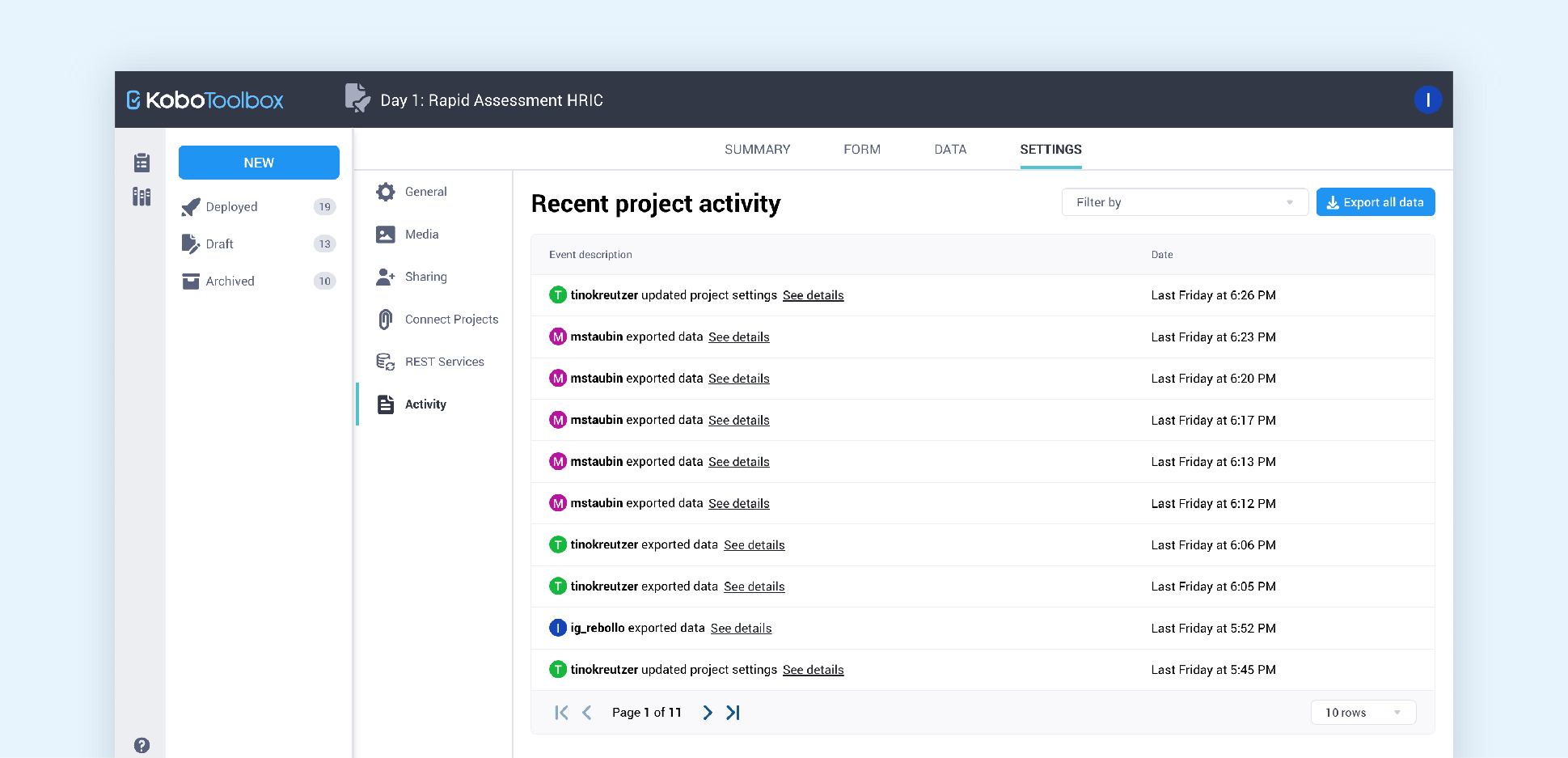
The following actions are captured in project history logs:
Category |
Actions |
|---|---|
Project |
Project name changes, deployment and redeployment, archiving and unarchiving, REST service updates, and project connections. |
Form |
Form edits, XLSForm uploads, creation of qualitative analysis questions. |
Data |
Data exports, media file changes, deletion or modification of submissions. |
Permissions |
Changes to user access or public access settings, ownership transfers. |
Note: Adding submissions appears in exported logs, but not in the KoboToolbox interface.
You can filter the project history log by action to quickly see updates to specific parts of the project.
To filter your project history logs:
In the project SETTINGS > Activity page, click on Filter by above the project history logs table.
From the dropdown menu, select an action to filter the table.
From the project SETTINGS > Activity page, you can also export all project history logs. To do so:
Click on Export all data in the top right corner of the table. Clicking this button will trigger the data export process.
Once the process is complete, you will receive an email with a link to download the file.
How long it takes to receive the email depends on the size of the log data.
Clicking the URL in the email starts the download of the CSV file or opens a new webpage, depending on your browser settings.
Did you find what you were looking for? Was the information clear? Was anything missing?
Share your feedback to help us improve this article!