
Search the knowledge base, browse our resources, and visit our Community Forum for more detailed information
Last updated: 24 Nov 2026
KoboToolbox’s natural language processing tools include automatic translation using machine translation (MT), which can translate completed audio transcripts and responses to text questions into other languages for review and analysis.
You can translate individual audio transcripts or text responses, or process multiple submissions in bulk from the data table. This article explains how to translate text manually or automatically, review completed translations, and manage translation usage limits.
Note: Automatic translation is not available for all languages. For unsupported languages, you can add translations manually.
To translate open-ended responses, your project must contain either:
Audio responses with completed transcripts.
Written responses collected through a Text question.
To translate an open-ended response:
Open your project and go to DATA > Table.
Click Open next to the audio or text response you want to translate.
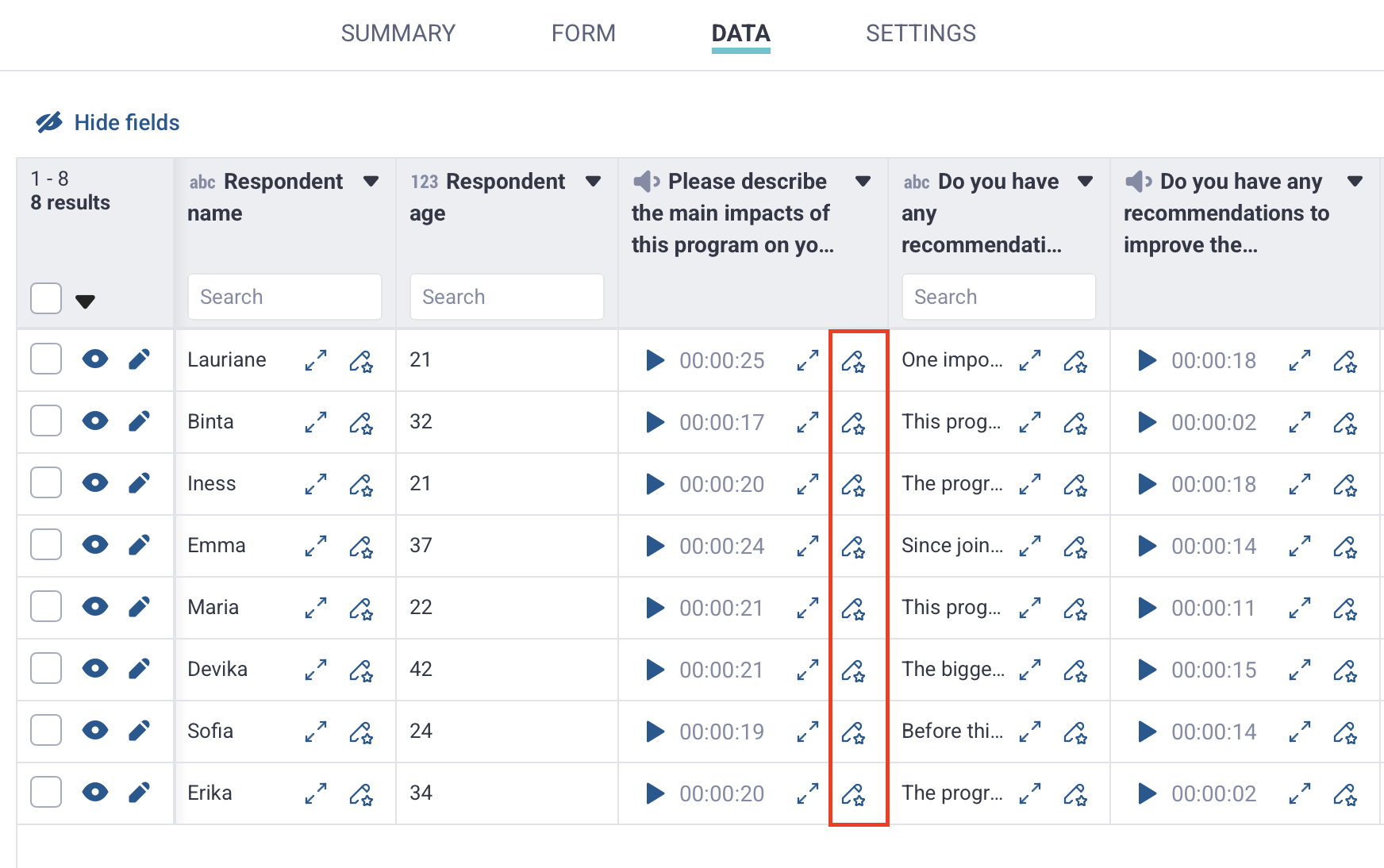
Go to the TRANSLATIONS tab and click begin.
For text questions, select the original language of the text response.
Select the language you want to translate into.
If available, select automatic to generate the translation automatically. Select manual to translate the transcript yourself.
If using automatic translation, click create translation.
Review the completed translation and make any necessary edits.
Use the original transcript and audio recording to check the translation as needed.
Click Save.
When finished, click new translation to add another translation, use the arrows to move to another submission, or click DONE to return to the data table.
When you return to the data table, the translation appears in a new column and can be downloaded alongside your survey data. You can add multiple translations to the same transcript.
Note: Automatically generated translations must be saved to prevent data loss. Navigating away from the page without saving may result in losing the translation.
You can automatically translate multiple audio transcripts at once from the data table.
Note: Bulk translation is not currently available for text responses, but this feature will be available in a future update.
To translate audio transcripts in bulk:
Open your project and go to DATA > Table.
Select the submissions you want to translate using the checkboxes on the left.
In the column containing the transcripts, click the arrow in the column header.
Select Translate selected transcripts.
Search for and select the target language.
Click Create translation.
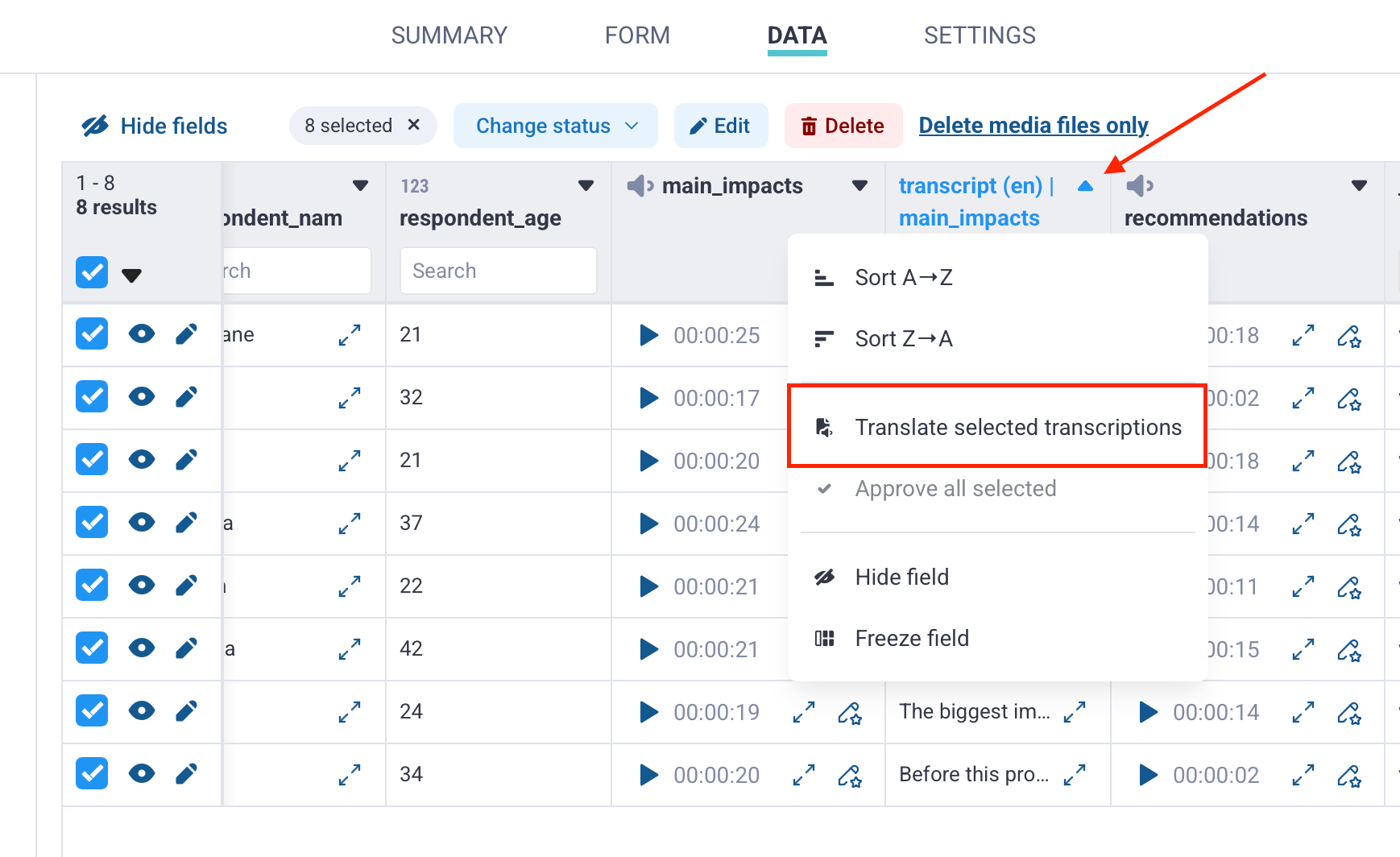
Bulk translation runs in the background, so you can continue working in other parts of KoboToolbox while it is processing. Completed translations are added to a new column in the data table and marked as ready for review.
If the selected responses exceed your remaining translation limit, you may need to select fewer rows before starting the bulk translation.
Always review automatically generated translations before using them for analysis.
To review and approve an individual translation generated through bulk translation:
Click Review.
Make any necessary edits.
Save the translation and move to the next submission.
To approve multiple translations at once:
Select the relevant submissions using the checkboxes on the left.
In the translation column, click the arrow in the column header.
Click Approve all selected.
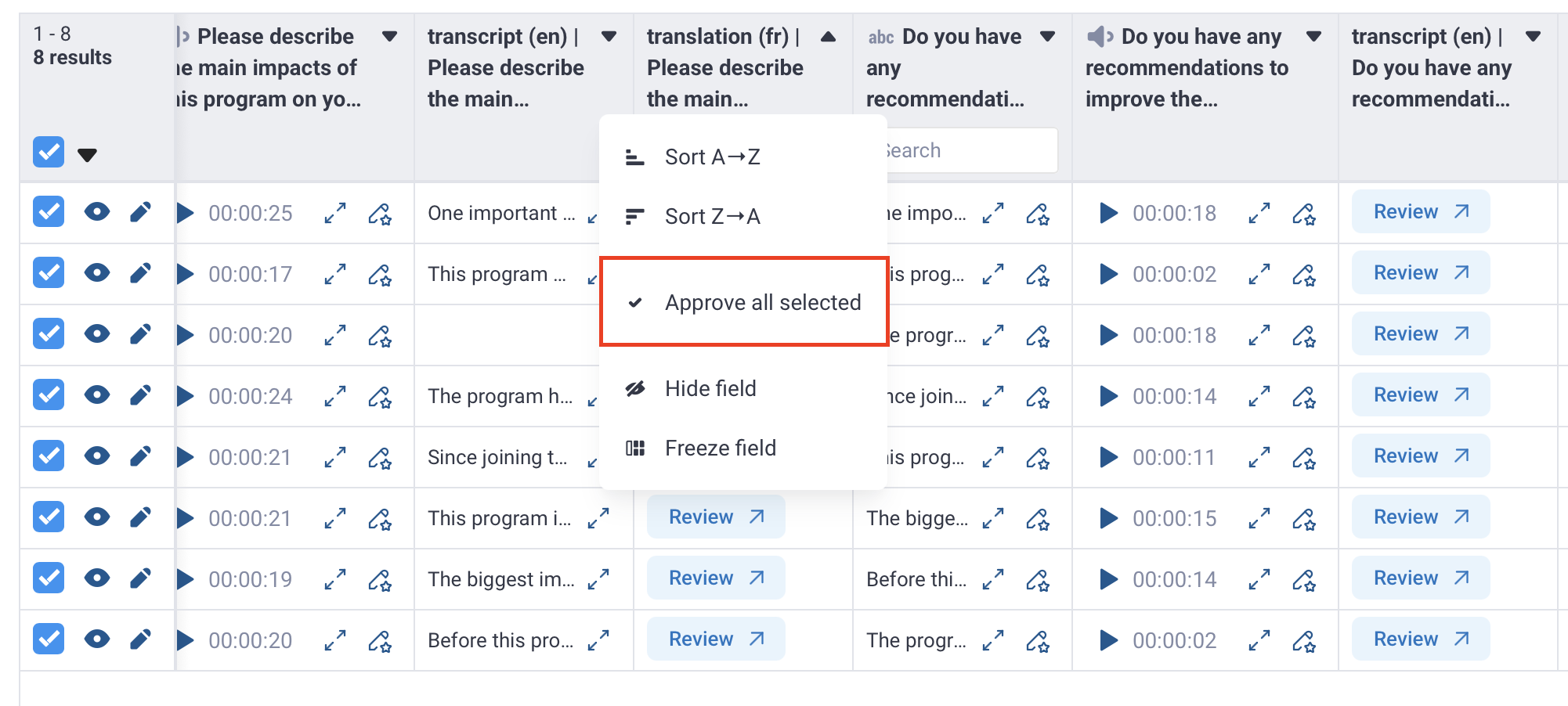
KoboToolbox supports machine translation (MT) for supported languages. MT capabilities are provided by Google Cloud Compute, which currently offers automatic translation in 129 languages.
Note: Text is sent to the external translation service only for the time required to process it. It is not stored by the service after processing or used to improve the service.
For manual translation, you can select from approximately 7,000 living languages based on the ISO 639-3 list maintained by SIL International.
When translating an audio transcript, make sure the correct original language was selected during transcription. If the transcript language does not match the selected language, automatic translations may be inaccurate.
If you cannot find a language in the list, try searching for an alternative spelling or name. Language names are listed in English. Some languages may also be listed under an alternative name.
For a full list of supported languages for automatic translation, see Languages supported for automatic transcription and translation.
Community Plan users can automatically translate up to 6,000 characters per month. Automatic translation counts towards this limit whether responses are processed individually or in bulk.
If you need additional translation capacity, you can upgrade to a plan with a higher quota or purchase a Natural Language Processing (NLP) Package add-on. You can also continue translating responses manually without a usage limit.
Did you find what you were looking for? Was the information clear? Was anything missing?
Share your feedback to help us improve this article!